

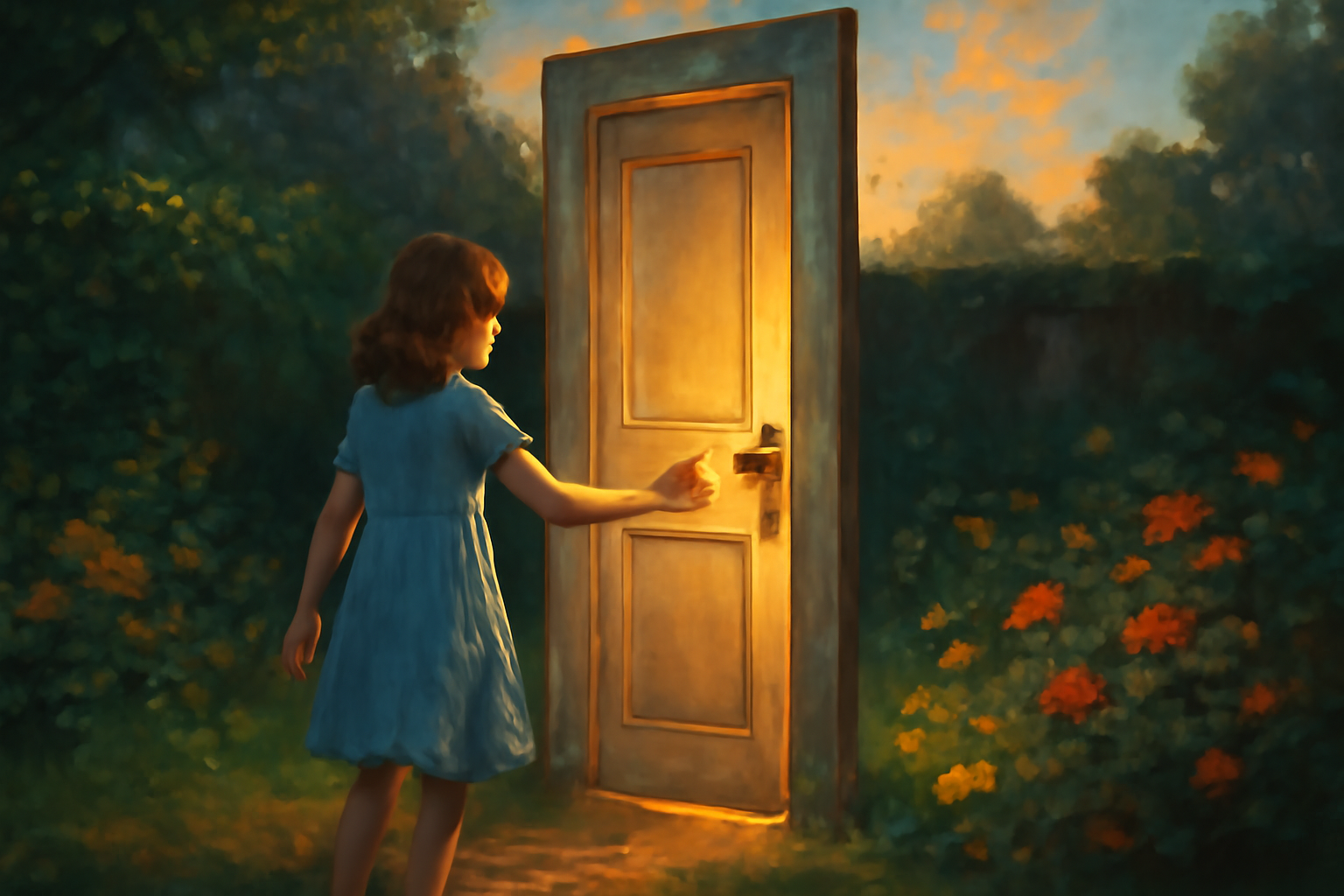
The day the door appeared, the morning sunlight was still stretching itself awake over the rooftops, and ten-year-old Mira Owens was trying to convince a ladybug to ride on her fingertip. She wasn’t expecting anything unusual — not in her quiet town, not in her own small, hedge-lined backyard where nothing exciting ever happened except when the neighbor’s cat came to nap on the warm paving stones.
But when she stood up and brushed the grass from her knees, she saw it.
A door.
Not a shed door. Not a gate. Just… a standalone door. Freestanding. Without a wall. Without hinges. Without even a latch. A smooth wooden frame with peeling white paint, standing upright in the middle of the garden as if it had been planted there overnight.
Mira blinked, then rubbed her eyes, then circled it twice the way a puzzled dog might circle a new object.
It didn’t vanish.
“Mom?” she called tentatively toward the kitchen window.
Her mother, elbows deep in dishwater, waved without looking. “In a minute, sweetheart!”
Mira looked back at the door. The doorknob — brass, a little tarnished — caught the morning light and glinted at her like a wink.
The kind of wink that meant go on.
So Mira went on.
She turned the knob.
And stepped through.
The garden disappeared, replaced by warm golden light and the smell of cinnamon toast. Mira felt a soft breeze, but it wasn’t the outside kind — it was the kind that lived inside cozy kitchens. She knew this place. She knew it deep in her chest.
It was her grandmother’s kitchen.
Not as it looked last year, or the year before, when Grandma Eleanor had grown quiet and tired. No — this was the kitchen from five years ago, when Grandma still hummed while kneading dough and always had flour on her apron.
“Pumpkin?” a warm voice said.
Mira turned. Her grandmother stood there — younger, stronger, smiling with her entire face.
Mira’s breath caught. Her knees wobbled.
And then she was running into her grandmother’s arms.
For a few perfect seconds, nothing existed except that hug — the familiar softness, the scent of lavender, the way her grandmother held her like she’d waited all day just to do it.
“I’ve missed you,” Mira whispered into her apron.
Her grandmother stroked her hair. “I know. But I’ve been right here.” She tapped Mira’s chest gently. “And here.” She tapped her forehead. “And apparently,” she added with a laugh, “in magic doors you find in gardens.”
They cooked toast together — Mira spreading the butter all the way to the edges the way Grandma taught her — and talked about nothing and everything. It felt bright. It felt right.
But eventually the light began to soften, and the edges of the kitchen blurred like a watercolor painting touched by a drop of water.
“It’s time to go, pumpkin,” Grandma said softly.
“Will I see you again?”
Her grandmother’s smile was the same warm shape it had always been. “Open the door again. You’ll find what you need.”
The kitchen dissolved into gold light.
And Mira stepped back into her garden, breathless and holding a crumb of cinnamon toast in her hand — proof that it hadn’t been just a dream.
Word of the door stayed between Mira and her mother for exactly twelve hours.
She tried to keep it secret. She really did. But after dinner, she found her mother sitting at the table, shoulders slumped, staring at a postcard from Mira’s father — who was on the road again for work, as always.
He’d miss her school play. Again.
Her mother wiped her eyes quickly when she saw Mira. “Oh, don’t look at me like that. I’m being silly.”
Mira hesitated. Then she took her mother’s hand and led her outside.
When her mother saw the door, she froze. “Mira… what on earth…?”
“Just open it,” Mira whispered.
Her mother’s fingers trembled as she turned the knob.
And she stepped into her own memory.
Mira couldn’t see what her mother saw — the door closed behind her, disappearing into its own world. But she heard a laugh — an unmistakable laugh — her mother’s laugh from years ago. The kind Mira had only seen in old photos.
When her mother finally stepped back into the garden, her cheeks were wet but her smile brighter than it had been in months.
“Your father and I…” she whispered shakily, “…he used to dance with me under the streetlights after our night shifts. We didn’t have much money. But we had that. I forgot how happy we were.”
The door had shown her something good. Something she needed.
After that, keeping the door a secret felt wrong.
Small miracles shouldn’t be hidden.
People came quietly at first — neighbors, friends, a couple from down the street who seemed always tired, a teenage girl who’d been bullied at school, a retired teacher who missed her late husband.
Each person stepped through the door.
And each came back softer. Lighter. Holding something invisible but precious — hope returned to their pockets, joy settled back into their bones.
Because the door didn’t just show old memories.
It showed happy ones.
Forgotten ones.
Ones that healed.
The couple down the street saw the first day they adopted their rescue dog, who had since passed — the way he bounded toward them, tail whipping like a flag of pure delight.
The teenage girl saw her baby brother’s face the first time she made him laugh.
The retired teacher saw her wedding day — not the formal ceremony, but the moment afterward when her husband tied a string of tin can bells to their old car “just to make a joyful noise.”
People didn’t talk much about what they saw. They didn’t need to.
You could see it in the way they left — shoulders squared, hearts lighter, eyes brighter.
The town grew softer, kinder, more patient with each other.
Hope bloomed like wildflowers.
And the door just kept standing there — humble and miraculous all at once.
But Mira worried.
What if it stopped working?
What if one day she stepped through and found nothing at all?
She waited until dusk when the fireflies emerged, tiny lanterns flickering among the shrubs. She took a deep breath, touched the knob, and stepped through.
Warm sunlight met her.
Only… it wasn’t a kitchen.
It wasn’t her grandmother.
It wasn’t a memory she recognized.
It was a moment she hadn’t lived yet.
There, in a field of sunlit dandelions, stood her father — older, softer, smiling at someone she couldn’t see.
“Mira,” he laughed, “come here!”
She turned. She saw herself — older by a few years — running toward him, leaping into his arms. They spun in a circle while the dandelion fluff danced around them like tiny floating stars.
She heard their laughter, bright and real.
A future happy memory.
A promise whispered gently by whatever magic lived in the door.
When she stepped back into her garden, the sky had gone indigo. Her mother was waiting on the patio, sipping tea, watching the stars.
Mira climbed onto her lap and nestled close.
“Mom,” she said softly, “I think everything’s going to be okay.”
Her mother kissed her hair. “I know, sweetheart.”
And in the garden, the door stood quiet and beautiful — a small miracle rooted in the earth, opening not just to memories, but to hope.
A reminder that joy, once planted, grows back — again and again.
Even when we forget where we left it.